Looking for the latest information on C Programming Gate 2015 Recursion? We've gathered comprehensive data, records, and insights about C Programming Gate 2015 Recursion.
Key Details
Explore the primary sources for C Programming Gate 2015 Recursion.
Recent Updates
Stay updated on C Programming Gate 2015 Recursion's latest milestones.
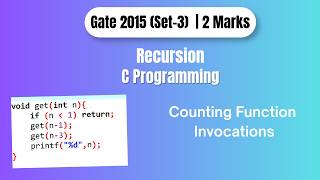
Gate 2015 pyq C Programming | Consider the following recursive C function. If get(6) function.
22 Algorithm | Gate 2015 Question | Consider the following recursive C function, If get(6) function
GATE 2015 SET-1 | C PROGRAMMING | FUNCTIONS | SOLUTIONS ADDA | GATE TEST SERIES | EXPLAINED BY VIVEK
GATE 2015 C Programming PYQ | Count Recursive Function Calls | Recursion
GATE 2015 SET-1 | C PROGRAMMING | SOLUTIONS ADDA | GATE TEST SERIES | EXPLAINED BY VIVEK
C_108 Recursion Solved Problem (GATE 2016 Question) | C Programming Tutorials
Programming Language GATE-2015 Problem Solution
GATE 2015 CS/IT C PROGRAMMING | get(6) how many times get() function is invoked | get(n-1); get(n-3)
Programming Language GATE-2015 Problem Solution
Gate 2015 pyq C Programming | Consider the following recursive C function. If get(6) function.
Programming Language GATE-2015 Problem Solution
Full Guide
Data is compiled from public records and verified media reports.
Last Updated: October 31, 2026
Conclusion
For 2026, C Programming Gate 2015 Recursion remains one of the most talked-about information profiles. Check back for the newest reports.
Disclaimer: Disclaimer: All information is compiled from publicly available data, media reports, and analysis. Actual details may vary.
Summary
Dear Viewers, In this video lecture, In this video, we solve a GATE 2015 C Programming Previous Year Question (PYQ) based on Recursion and Counting Function ... Use my code JKL10 for EXTRA 10% OFF & enrolling & the MEGA COMBAT for FREE Aarohan for For any queries feel free to or direct message on Instagram Instagram - instagram.com/jatingupta5jan/ GATE ... Consider the following C function. int fun(int n) { int x=1, k; if (n==1) return x; for (k=1; k lessThan n; ++k ...